
For menopause-related skin changes, aesthetic treatments are gaining ground
- Most women are not aware of the effects menopause can have on their skin health and appearance
- More than 30% wished they had known about the effects of menopause on skin earlier
- Hormonal changes related to menopause reduce collagen, elastin and hyaluronic acid, and can cause wrinkles, dryness and loss of firmness
- Many women see aesthetic treatments as a key way of addressing menopause-related skin concerns
- Earlier education and menopause-specific clinical evidence on aesthetic treatments could support prevention and more personalized care
Of the 47 million women transitioning into menopause or perimenopause each year, most enter the change without a clear understanding of how this stage of life may affect their skin.1 More than half start menopause unaware of the changes it can bring, despite the significant influence of hormonal shifts on skin health and appearance.2
This knowledge gap can have serious consequences. Skin changes can affect much more than appearance – they can influence confidence and overall wellbeing. As conversations around menopause become more open, skin health must become a more prominent part of them.
What menopause means for skin
Starting in perimenopause, women experience a decline in the hormones supporting skin health, bone density and fat distribution.
These hormonal changes can affect several of the skin’s essential building blocks. Declining levels of estrogen lead to reduced elastin and collagen, which can cause skin to lose its firmness and increase the likelihood of wrinkles. Lower levels of hyaluronic acid can result in skin dehydration, dryness and itchiness.
Emerging research suggests that menopause also affects dermal white adipose tissue (dWAT), a small fat layer that helps to keep skin plump and structurally supported. As hormone levels change, dWAT may shrink and be replaced by stiffer tissue, which can contribute to thinner, more fragile skin.3
As the years go by, skin quality concerns often extend beyond the face to other visible areas. In a person’s 40s, neck lines often become more noticeable; in their 50s, the décolletage may show fine lines, dryness and pigmentation; and in their 60s, the hands and arms can also experience dryness and pigmentation.4
However, for many women, these changes can feel sudden or unexpected. They may also arrive at a time when women are already navigating a wide range of physical and emotional changes, compounding feelings of reduced confidence.
Building knowledge around menopause-related skin changes
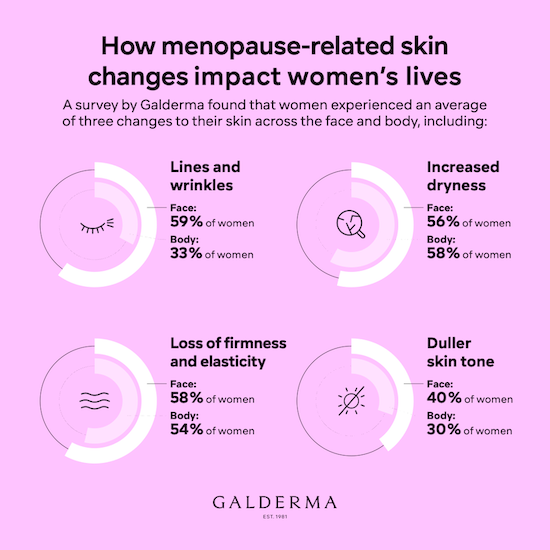
To better understand this experience, Galderma conducted a global survey in 2026 involving more than 4,300 perimenopausal and menopausal women from five continents.5
Participants highlighted the persistent knowledge gap around menopause and its aesthetic impact. Most women surveyed did not learn about effects of menopause on skin until their 40s, and more than 30% wished they had known earlier. Even women with knowledge on the topic were unprepared for the experience, with more than half being neutral or dissatisfied with their understanding. This demonstrates that awareness is not enough – women also need clear and practical information about what to expect and the options available to them.6
Another common theme uncovered by our survey was the extent of menopause impacts on women’s physical and mental wellbeing. On average, menopausal women experienced three skin changes on the face and body, including wrinkles, increased dryness and duller skin tone. These changes had a clear psychological impact, with women feeling more anxious (57%) and less attractive (60%), less confident (55%) and less social (46%).7
“The hormonal changes that come with menopause significantly affect the skin – decreasing collagen, elastin and hyaluronic acid can result in loss of firmness, wrinkles and dryness. This accelerated deterioration in skin health can impact women’s confidence and self-perception. It’s therefore important that this forms a core part of menopause conversations and that women understand there are solutions, like aesthetic treatments, that can prevent or reverse these changes and make women feel more like themselves again.”
— Dr. Doris Day
Board-certified dermatologist, U.S.
Growing interest in aesthetic treatments
Our survey also showed that there is a growing interest in aesthetic treatments as a key way of addressing menopause-related skin concerns. Many women said they would consider aesthetic treatments targeting specific concerns, such as wrinkle treatments (47%), hyaluronic acid treatments (41%) and biostimulators (30%). The 15% of women who had undergone aesthetic treatments reported greater satisfaction with their knowledge of menopause than their peers, suggesting that aesthetic procedures support better education and knowledge around the impact of menopause on the skin.
Additionally, Galderma’s survey revealed a gap around preventative aesthetic treatment for menopause-related skin changes. Only 26% of women surveyed see aesthetic treatments as preventative, yet 61% say they would have acted differently if they had been informed at an earlier age.
This points to a broader need for the aesthetics community to move beyond responding to established concerns and begin educating women earlier, before changes set in.
Advancing awareness and science-led innovation
At Galderma, advancing dermatology for every skin story means recognizing the different ways in which skin evolves throughout life, including during perimenopause and menopause. Our global survey is one part of a broader effort to deepen understanding, improve education and support more personalized treatments. In addition to this survey, Galderma has made the pioneering decision to incorporate menopausal status as a standard parameter in all our clinical trials for injectable aesthetics. By integrating these insights into what we do, we are not only elevating awareness, but also advancing science-backed aesthetic solutions specifically tailored for women navigating this change. Our goal is to provide healthcare professionals with the robust evidence needed to support women effectively through this transition.
This is an important step because hormonal status can influence skin’s structure, function and response to treatment. Collecting this information will help build a more robust evidence base, giving healthcare professionals deeper insight into how aesthetic treatments may support menopausal patients, and helping women feel informed and confident throughout this period of life.
References
- Wright VJ, Schwartzman JD, Itinoche R, Wittstein J. The musculoskeletal syndrome of menopause. Climacteric. 2024;27(5):466-472. doi:10.1080/13697137.2024.2380363
- Galderma. Data on file. Menopause Patient Survey.
- Wright VJ, Schwartzman JD, Itinoche R, Wittstein J. The musculoskeletal syndrome of menopause. Climacteric. 2024;27(5):466-472. doi:10.1080/13697137.2024.2380363
- Galderma. Data on file. Menopause Patient Survey.
- Galderma. Data on file. Menopause Patient Survey.
- Galderma. Data on file. Menopause Patient Survey.
- Galderma. Data on file. Menopause Patient Survey.